Category: Getting Started

  • What You Actually Get for $179 a Month vs. $4,000 Upfront

    What You Actually Get for $179 a Month vs. $4,000 Upfront

    Could the lower monthly payment hide a higher long-term cost? When cash flow matters, the right choice depends on more than the advertised price. This comparison asks what a business receives for a recurring payment versus an upfront investment: ongoing service, ownership, flexibility, and control. The goal is not simply to spend less money in one month, but to choose the option that delivers lasting value.

    Consider a new car. Under the 1% rule, a $40,000 vehicle may have a lease near $400 per month, but credit, rates, term length, mileage, insurance, and fees can change the real cost. The same principle applies to website plans: a low payment does not always mean a lower total price.

    One website option may bundle hosting, updates, security, and support. Another may provide full ownership upfront, while the buyer handles maintenance, software, and future fixes. This guide uses car and housing examples only as context while focusing on the website decision.

    A $4,000 mortgage payment may support different home prices depending on rates, taxes, insurance, loan term, and down payment. Those variables show why every payment needs context before a buyer chooses an affordable small-business website plan.

    What You Actually Get for $179 a Month vs. $4,000 Upfront

    Website pricing can look simple until service length, ownership, and future needs enter the picture. A $179 monthly payment may cover ongoing care, while a $4,000 upfront price may cover launch work and direct ownership. A lower monthly amount can protect cash flow, but the full deal matters more than the smallest number. Compare the total cost, included services, cancellation terms, renewal rules, and asset ownership before choosing.

    A detailed and visually engaging comparison chart illustrating website payment plans. In the foreground, two distinct sections: one showcasing a monthly payment plan labeled "$150/month," and the other representing an upfront cost of "$2,000." Each section features icons and symbols representing services included like hosting, design, and support, with color coding for clarity. In the middle ground, a professional-looking individual in business attire analyzes the chart thoughtfully, possibly pointing at the monthly plan. The background includes an office environment with soft natural lighting filtering through a window, enhancing the mood of professionalism and deliberation. Use a slightly elevated angle to capture all elements harmoniously, ensuring a clear and informative presentation without text or distractions.

    The Core Difference Between Monthly Cost and Upfront Price

    Consider a new car. Under the 1% rule, a $35,000 sedan may have a lease near $350 per month, while a $50,000 SUV may have a lease near $500. However, credit, interest, term length, mileage, incentives, signing fees, and the vehicle model can change the real cost. Use the same rule when comparing website services, car finance offers, or any other deal: review every payment instead of relying on one advertised price.

    Which Option Delivers More Value for a Small Business

    For a website buyer, subscription value may come from hosting, support, edits, security, and predictable payments. Purchase value may come from custom deliverables, ownership, and freedom to choose future providers. Housing examples also require context: a mortgage payment depends on the loan amount, rates, taxes, insurance, term, and down payment. It should not be presented as a direct equivalent of a website price.

    • Subscription value rests on support, hosting, edits, and security.
    • Purchase value rests on deliverables, ownership, and post-launch duties.
    • Compare cash needs, total payments, term, cancellation, and renewal rules before choosing.

    Each buyer should assess the purchase price, service scope, long-term value, and total amount due before signing a deal with a website provider. A dealer may use similar pricing tactics in vehicle offers, but a website provider should be evaluated by documented deliverables and support terms.

    Website Subscription vs. Buying a Website: How Each Model Works

    Business owners typically choose between ongoing access and direct ownership. This decision affects the payment, control, support, and future cost of a website. A subscription resembles a car lease: the buyer uses a managed vehicle without owning every component. Buying a website is more like using finance or a loan to purchase an asset, although a website contract is not necessarily an actual loan.

    A modern digital workspace scene, featuring a laptop displaying a sleek website with subscription payment options. In the foreground, a professional woman in smart business attire is reviewing the website, showcasing a thoughtful expression. In the middle, various payment icons like credit cards, PayPal, and subscription plans are subtly displayed around the laptop, symbolizing different payment methods. The background includes soft-focus elements of a stylish office, with a large window allowing natural light to flood the room. The lighting is bright and inviting, creating an atmosphere of productivity and professionalism. Use a wide-angle perspective to capture both the individual and the digital elements clearly, emphasizing the contrast between subscription and purchase. The overall mood should be focused and encouraging, promoting entrepreneurial spirit in small businesses.

    What a Monthly Website Subscription Typically Covers

    One monthly payment may include hosting, updates, security, backups, and technical help. Like a lease, a subscription may offer lower monthly payments because the provider spreads service costs across the term. However, lower monthly payments do not automatically mean a lower total cost. Buyers should ask whether cancellation ends access, support, stored files, or domain control. A clear deal should list renewal terms, service fees, and any applicable interest or insurance requirements.

    What You Own When You Buy a Website

    An upfront purchase may transfer the design files, content, source code, domain, hosting account, analytics, and integrations. The price can provide greater independence, but the owner may become responsible for hosting, maintenance, security, and future updates. Review each deal carefully, much like comparing vehicle finance offers from a dealer.

    • Confirm asset ownership, domain control, and transfer rights.
    • Separate service access from website files, code, and analytics accounts.
    • Check total cost, term, support duties, and cancellation conditions.
    ModelPrimary benefitMain question
    Subscription Lower monthly cost Does access continue after cancellation?
    Purchase Direct asset control Who handles hosting and updates?
    Car analogy Lease or vehicle ownership Are payments covering use or ownership?

    What a $179-a-Month Website Subscription Usually Includes

    A managed website plan places core digital tasks under one monthly payment. A $179 monthly price may include design updates, hosting, security, maintenance, and technical support, but every offer differs. The included amount matters more than the low monthly figure. At $179 per month, payments total $2,148 over 12 months before taxes, add-ons, or renewal changes.

    Design, Hosting, Maintenance, and Technical Support

    Many providers handle layout changes, domain settings, backups, hosting, and software upkeep. Ask whether the price includes domain registration, copywriting, SEO, accessibility work, analytics, emergency fixes, and third-party software. Support response time also shapes value, so confirm whether help arrives within one business day or under a longer term.

    Content Updates, Security, and Ongoing Improvements

    Regular edits can keep service details, offers, and contact data current. Strong security may include scans, patches, backups, and recovery tools. Confirm limits before signing a deal, including update hours, storage, traffic, backup frequency, and whether new features create additional charges.

    A car lease may show only the advertised lease amount, while insurance, maintenance, registration, interest, and other costs raise the total cost. The same rule applies to website deals: compare the full service package, not only the payment or advertised price.

    • Confirm hosting speed, backups, security duties, and software costs.
    • Ask about edit limits, SEO, accessibility, analytics, and support response times.
    • Review the term, cancellation rules, renewal fees, and signing requirements.
    • Compare total payments over several months with the site’s business value.

    A clear plan can preserve cash while keeping technical work on schedule, but buyers should verify every inclusion before choosing an offer.

    What You Get When You Pay $4,000 Upfront

    A $4,000 upfront website package can create a stronger foundation than a basic template. The purchase price may cover custom design, service pages, contact forms, copy placement, analytics, accessibility setup, SEO basics, and launch support. Clear deliverables turn one payment into a useful business asset. Confirm which costs are one-time and which recur monthly or annually before committing money.

    Custom Design and Business-Specific Features

    Ask whether revisions, booking tools, online sales, extra pages, migration, forms, and integrations appear in the deal. Content creation, accessibility improvements, and advanced SEO can also affect the final price. Confirm each item before signing, especially when the project requires special features or connects to another business system.

    Ownership of the Website Files and Assets

    Buyers should receive an inventory of layouts, images, copy, domain access, hosting credentials, analytics accounts, source files, and code. Ownership terms should cover transfer rights, backups, future edits, and access after the project ends. A buyer should know whether the upfront payment provides full control or only a license to use the website.

    What May Cost Extra After Launch

    Hosting, security, maintenance, premium software, support, redesigns, and content updates may create additional costs after launch. These expenses are separate from the $4,000 purchase price unless the agreement says otherwise. A car lease offers a useful comparison: the advertised payment may depend on credit, vehicle model, term, interest, mileage, incentives, and signing charges. Review website offers with the same care, but do not assume a website deal is a vehicle loan. Compare the full amount, recurring payments, support duties, and long-term value before choosing among deals.

    Website Ownership, Hosting, and the Long-Term Cost

    A lower monthly payment can protect cash, yet the total cost deserves close review. A $179 monthly plan reaches $2,148 after 12 months, $4,296 after 24 months, and $6,444 after 36 months, excluding taxes, fees, price changes, and added services. By contrast, a $4,000 upfront purchase may offer stronger value only when hosting, domain registration, maintenance, software, and redesign costs remain modest.

    Ownership and hosting remain separate. A business may own its files while another provider keeps the site online. Break-even timing depends on yearly service costs, not the headline price alone. A simple formula is: break-even period = upfront price divided by monthly savings, then adjust for recurring ownership expenses. This review works like comparing car lease terms, vehicle payments, loan rates, mileage, insurance, and long-term money needs.

    “The lowest payment is not always the lowest total cost.”

    • Review each asset inventory, hosting inventory, and transfer requirement.
    • Compare price, payment, support, renewal terms, and total payments.
    • Use the car lease rule: inspect the complete deal, not one figure.

    Mortgage math also shows why assumptions matter. A 30-year, $245,000 loan may carry about $312,000 in interest, while a 15-year term may carry near $123,000, depending on rates and the loan agreement. Property taxes and conventional PMI also vary by location, credit, down payment, and insurance requirements. Like car and vehicle ownership, website costs reward careful planning. Buyers should compare every payment, recurring charge, and service obligation before choosing the deal that provides the best long-term value.

    Affordable Payment Plans for Small Business Websites

    Early launch decisions often depend on cash flow, not just total price. A monthly payment can preserve money for payroll, inventory, marketing, and emergency reserves. That flexibility may help an owner publish sooner without draining working capital, but lower monthly payments do not automatically mean a lower total cost.

    Consider a small-business budget with $3,000 for payroll, $600 for marketing, $1,200 for inventory, and $500 reserved for unexpected expenses. A predictable website payment may be easier to manage than a large upfront charge. The buyer should still calculate every payment, renewal fee, and add-on before deciding how much cash the plan will require each month.

    How Lower Monthly Payments Make Launching Easier

    A payment plan can protect cash while site design, hosting, and support continue. Yet total cost, interest, service value, and the contract term deserve review. Lower monthly payments help only when fees remain reasonable and the agreement does not include mandatory charges, a balloon payment, or expensive cancellation terms.

    Questions to Ask About Contract Terms and Cancellation

    • How many months remain in the minimum term?
    • Does cancellation create fees or end site access?
    • Who owns the files after cancellation?
    • Do renewal charges or signing costs apply?

    Compare several deals and offers before signing, just as a car buyer reviews dealer finance options and lease terms. Vehicle deals may advertise a low payment while adding fees due at signing. Website buyers should request a written payment schedule, complete service scope, ownership terms, and cancellation clause before committing money. This step helps each buyer compare the real cost of every deal.

    The Hidden Costs Behind Each Website Pricing Model

    Headline pricing rarely shows every charge tied to long-term website care. Domain renewals, hosting, premium plugins, security tools, software subscriptions, payment processing, and maintenance retainers can increase the total payment over several months. Review whether each cost is monthly, annual, usage-based, or one-time before comparing the price of different deals.

    Renewal Fees, Hosting, Domains, and Maintenance

    Website offers may add domain registration, hosting upgrades, premium themes, API fees, accessibility remediation, content updates, SEO retainers, emergency support, migration, and cancellation charges. A $179 monthly payment may not include every service. Ask for an itemized inventory showing the amount due at signing, recurring payments, renewal rates, taxes, interest, and any insurance requirement.

    Use the same rule when reviewing website offers: request a complete cost schedule instead of trusting one headline price. Record every payment, renewal, and finance charge before signing. This process helps buyers compare cash needs, value, and total cost over the full term.

    Redesigns, Integrations, and Additional Business Needs

    Ask whether redesigns, booking tools, online payments, extra locations, e-commerce features, accessibility work, or integrations create new charges. A car lease may add mileage fees, insurance, and dealer incentives. Website deals can work the same way: the base model may look affordable, while added features raise the cost. A vehicle offer is only an analogy, so evaluate website-specific services rather than assuming dealer finance terms apply.

    • List monthly payments, renewals, support fees, and usage charges.
    • Check hosting, plugin, security, software, and API rates.
    • Compare lease-style access with ownership, loan-style obligations, and cancellation terms.

    Clear records reveal the real price, protect money and cash flow, and support smarter finance decisions.

    Which Option Builds More Business Value Over Time?

    Long-term business value depends on ownership, lead flow, conversion rate, brand control, performance, and total spending. The best payment plan supports growth without hiding its true price. Buyers should measure leads, conversion rate, uptime, organic traffic, page speed, accessibility, and cost per acquisition before deciding whether a subscription or upfront purchase creates more value.

    Vehicle leasing offers useful context, but it is only an analogy. A car lease depends on the vehicle model, term, mileage, interest, incentives, and residual value. A used car may retain value, while another used car may lose it quickly; the same is true when comparing a new or used option for your next car. Website ownership works differently, so do not treat a lease deal or vehicle payment as proof of website value.

    A website subscription can create strong value when regular improvements generate leads, increase conversions, improve uptime, strengthen organic traffic, or prevent costly failures. Its monthly payment may support cash flow at a predictable amount per month, even though ownership may remain with the provider. Lower monthly payments can be worthwhile when the ongoing service produces measurable business results.

    An upfront website purchase may create greater value when business needs remain stable and the owner has enough cash. Direct control of files, hosting, and future providers can protect money and reduce dependence on one vendor. A $4,000 housing payment would also depend on location, rates, taxes, insurance, loan term, and down payment, so it should not be used as a direct measure of website value.

    Use the total-cost rule: judge performance, ownership, and future flexibility together.

    • Compare price, payment, total cost, and loan-style obligations.
    • Review lease deal limits, mileage, interest, renewal rules, and incentives only as an analogy.
    • Choose deals that match growth plans, platform lifespan, measurable results, and cash needs.

    How to Compare Website Offers Before You Sign

    Before signing, place every promise beside measurable proof. Compare design scope, hosting, support response, ownership, backups, analytics, security, accessibility, scalability, and cancellation rights. Request written offers that list each feature, renewal charge, deliverable, payment, and total cost. Then compare two proposals side by side instead of choosing the lowest advertised price.

    Features, Support, Ownership, and Flexibility

    Confirm source-code ownership, CMS credentials, file access, domain ownership, data-export options, backup frequency, accessibility responsibilities, SEO ownership, transfer rights, and post-cancellation access. Review support rates, response times, hosting limits, service-level agreements, and renewal terms. Each provider should show a current service inventory, recurring charges, signing requirements, and total price. Replace generic insurance duties with clearly defined website responsibilities unless insurance is part of the contract.

    Car finance offers use similar assumptions, but the comparison is only an example. An advertised car lease may depend on Tier 1 credit, mileage limits, interest, incentives, dealer fees, and the vehicle term. A money factor of 0.00150 equals roughly 3.6% APR under the 2,400 rule. Review these details before comparing a vehicle, lease deal, or loan payment, but do not assume car finance terms apply to a website offer.

    Questions to Ask About Performance and Scalability

    • Will page speed, mobile usability, search visibility, uptime, accessibility, and SEO performance meet business goals?
    • Can traffic capacity support growth, new locations, and future integrations?
    • Do monthly payments, cancellation terms, renewal rates, and support costs match available money?

    Buyers should judge documented results, not promotional claims from a dealer or provider. Ask each website provider for references, performance data, ownership terms, and a complete payment schedule. Review every deal before signing so the buyer understands the price, obligations, and long-term value.

    When a Subscription or Upfront Website Purchase Makes Sense

    Choose based on cash flow, control, business stage, and total cost. A subscription suits a startup with limited cash, uncertain requirements, or a need for steady design, hosting, maintenance, and support. A predictable monthly payment can protect money during the first month and preserve funds for growth, but lower monthly payments do not guarantee a lower overall price.

    An upfront purchase fits an established firm with cash reserves, stable needs, and clear goals. Ownership can provide provider freedom, custom integrations, source-file access, and potential savings across several years. Compare the purchase price, support term, scalability, expected website lifespan, ownership rights, and recurring costs before signing any deal.

    A brief car comparison can provide context. A reliable used car may be more practical than an unaffordable new car payment, just as a subscription may suit a business that needs flexibility more than immediate ownership. A vehicle lease deal depends on mileage, rates, interest, insurance, credit, and incentives, but those factors should not distract from the website decision.

    • Pick subscription plans when cash flow, flexibility, and ongoing care lead.
    • Choose ownership when stable needs, cash reserves, and long-term control outweigh the upfront payment.
    • Compare monthly payments, cancellation terms, support, scalability, ownership, and total value.

    Before choosing a deal, the buyer should compare finance-style obligations, payment schedules, and risk. Whether you plan to buy a car or select your next website provider, smart buyers review the full agreement rather than focusing on one monthly amount. Confirm rates, term length, mileage or usage limits, incentives, insurance responsibilities, and every recurring charge before committing.

    Conclusion

    Choosing between website access models starts with total cost, not headline price. A recurring plan can work well when hosting, maintenance, support, updates, and security remain included in the monthly payment. This setup may protect cash flow and keep technical tasks on schedule, but a lower monthly payment does not automatically create lower total cost.

    At $179 per month, payments total $2,148 after 12 months, $4,296 after 24 months, and $6,444 after 36 months, before additional fees or price changes. The upfront alternative is $4,000. Compare these amounts with hosting, domains, maintenance, software, renewal fees, service limits, and cancellation charges. Taxes and insurance may apply only when the website agreement specifically includes them.

    An owned site may offer stronger long-term value when files, accounts, assets, and platform access transfer to the business. Like a car lease, one low payment can hide added obligations, while a vehicle purchase or loan may involve different ownership and payment terms. Keep enough money available for growth and unexpected repairs, then choose the model that fits your cash reserves, technical skills, business goals, and support needs.

    Before signing a deal, each buyer should request an itemized proposal, confirm ownership rights, review the term and cancellation rules, and calculate every payment. Smart buyers compare the full agreement rather than choosing based on one monthly amount. Clear terms turn website spending into a confident small-business decision.

  • Why We Charge Monthly for Websites Instead of One Big Upfront Fee

    Why We Charge Monthly for Websites Instead of One Big Upfront Fee

    A strong online presence helps a small business earn trust before a first call or visit. Our £50-per-month plan makes that goal easier, with a no upfront cost website for businesses that want to get started without a large initial bill.

    This monthly website subscription includes bespoke mobile-ready design, clear content, SEO support, and fast hosting. It gives your brand more than a basic template. Each page is shaped to support your message, guide visitors, and help your business look ready to serve.

    Speed matters when customers search online. We deliver your new site in under one week, helping you build credibility while a traditional agency project may still sit in planning. The process uses 90% AI and 10% human oversight, so modern tools improve speed while specialists protect quality.

    You can also move forward with greater confidence. A 30-day money-back guarantee gives you time to review the result and decide if it fits your needs. This pay monthly approach keeps the initial cost manageable while providing a polished web presence from the start.

    Why We Charge Monthly for Websites Instead of One Big Upfront Fee

    Launching a professional online presence should not force a small business to drain its cash reserve. Our $50-per-month plan spreads the investment, so owners can keep funds available for growth.

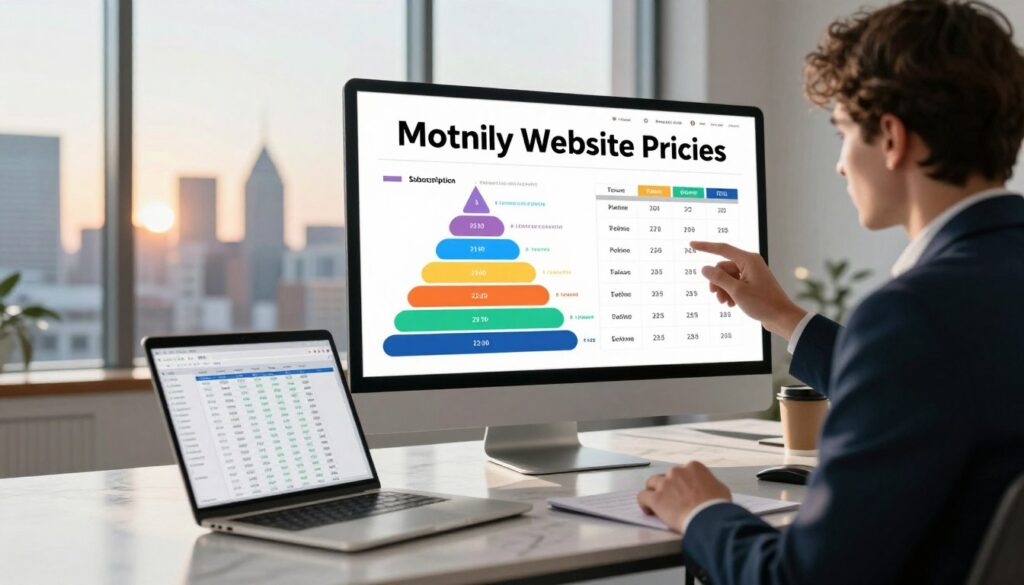
    A modern office scene showcasing a sleek, digital display board featuring monthly website pricing charts. In the foreground, an elegant marble desk with a laptop open, displaying a pricing spreadsheet. The middle section reveals a dynamic graphic of monthly subscription tiers, color-coded and detailed, radiating professionalism. To the back, a glass window reveals a vibrant city skyline under soft morning light, symbolizing growth and opportunity. Warm, natural light gently illuminates the space, casting soft shadows, creating an inviting atmosphere. A person in smart business attire analyzes the pricing chart, looking engaged and thoughtful, enhancing the scene's focus on strategy and value. The overall mood is optimistic and contemporary, ideal for illustrating financial planning without any text elements.

    The challenge of a large upfront website cost

    Traditional agencies often quote $3,000 to $8,000, with a large upfront deposit. Even a smaller project may reach $3,000 to $7,000 before launch. That amount could cover staff, inventory, rent, or marketing instead.

    A pay monthly website offers a practical alternative. Clear terms show the fee, setup, and ongoing service before the project begins. There are no surprise setup fees or confusing contracts.

    How predictable payments support business cash flow

    Predictable payments make planning easier each month. The service can include hosting, maintenance, support, and future updates, rather than leaving owners with technical work after a one-time handoff.

    • Start with a smaller initial commitment.
    • Protect funds for daily business needs.
    • Keep professional website care in one simple plan.

    This approach gives businesses more control while keeping the project moving forward.

    Monthly Website Subscription, Pay Monthly Web Design, No Upfront Cost Website Options

    A monthly website subscription can cover the full journey, not just access to a platform. The £50-per-month plan includes strategy, hosting, SEO, content, and a free domain name. It also includes a clear setup process with no upfront fee.

    A modern workspace scene showcasing the concept of "pay monthly website options". In the foreground, a sleek computer desk with a high-end laptop displaying a website payment plan interface, featuring monthly payment buttons and attractive design elements. The middle ground shows a diverse group of young professionals in smart business attire, engaged in discussion, pointing at graphs on the screen, embodying teamwork and collaboration. In the background, a bright and inviting office environment with large windows letting in natural light, potted plants, and informal seating arrangements, creating an approachable atmosphere. The overall mood is optimistic and innovative, emphasizing accessibility and modern business solutions, captured with a warm color palette and soft focus.

    Unlike a DIY builder, pay monthly web design gives your business expert help with structure, messaging, mobile layout, and search visibility. You receive a polished site without handling every technical task alone.

    • Simple monthly payments for easier planning
    • Professional website design shaped around your needs
    • Hosting, SEO, content, and domain management in one service

    After 12 monthly payments, ownership transfers to you. This gives the plan lasting value and control. Advanced e-commerce tools or extensive custom development may need a separate quote.

    Plan feature What you receive Key benefit
    Core package Design, hosting, SEO, content, and domain name Ready-to-use online presence
    Payment terms £50 per month with no upfront fee Predictable business planning
    Ownership Transfers after 12 payments Long-term control

    What a Pay Monthly Website Includes

    Your plan brings the key tools needed to build trust and support steady growth. It combines creative work, technical care, and search support in one clear package.

    Custom website design built around your brand

    A custom website reflects your brand, industry, services, and ideal customer. The layout, colors, page flow, and message fit your goals instead of forcing you into a generic template. Each page guides visitors toward a useful action.

    Hosting, security, domain management, and maintenance

    Premium hosting supports fast loading and reliable access. Listed uptime reaches 99.9%, with another specification reaching 99.99%. SSL security, backups, domain name management, plugin updates, and technical support help protect your online presence.

    Reliable technology gives small businesses more time to serve customers.

    Content, SEO, and mobile-friendly performance

    Professional content, keyword research, page formatting, and site structure help search engines understand your offer. Google Search Console setup adds useful insight. Responsive pages work across phones, tablets, and desktops.

    • Bespoke brand-focused presentation
    • Secure hosting with routine updates
    • SEO-ready content and mobile performance

    Professional Website Design Without the Financial Barrier

    Expert digital work can be within reach, even when a business must protect its cash flow. A polished new website should reflect your brand, not look like a rushed template.

    Why quality does not require a cheap template

    Off-the-shelf layouts often limit your message, page flow, and customer journey. Our bespoke approach shapes each page around your goals, services, and audience. Professional content, clear calls to action, and human review help create a stronger result.

    Digital Shift has operated since 2007, backed by more than 15 years of agency experience. That knowledge supports a pay monthly website that feels carefully planned rather than mass produced. AI can assist with production, while specialists check tone, accuracy, and usability.

    How subscription pricing makes expert web design more accessible

    Traditional websites often require an investment of £3,000–£7,000 or more. A smaller fee with monthly payments spreads that burden, helping a business access experienced experts sooner. The upfront cost stays manageable, while the service still supports strong website design.

    • A pay monthly website supports steady cash flow.
    • Pay monthly websites can include bespoke content and setup.
    • The monthly website plan combines quality with practical value.

    This model makes professional web design easier to start without lowering standards.

    How Our Monthly Website Design Process Works

    Clear steps help each project move from idea to launch with confidence. You can get started quickly and see progress during the first seven days.

    Days 1–2 focus on your business, audience, industry, and competitors. The team reviews your goals and content needs before planning the page structure. This research gives the pay monthly website a useful direction from the start.

    During Days 3–4, AI tools support the layout and SEO-focused content. Specialists guide the website design, check the message, and shape the web design around your brand. This saves time while keeping the work clear and purposeful.

    Day 5 brings UK-based quality checks. The team reviews mobile display, links, page speed, spelling, and search setup. Day 6 gives you time to review the site and request updates.

    On Day 7, the approved monthly website launches with hosting included. The process takes under one week, giving small businesses a simple path from planning to a live business website.

    Time Focus Result
    Days 1–2 Research and brief Clear site plan
    Days 3–4 Layout and content SEO-ready pages
    Days 5–6 Checks and review Refined final version
    Day 7 Launch and hosting Live online presence

    Fast Website Launch With AI and Human Expertise

    A focused process turns an idea into a polished online presence in days. Our 90% AI and 10% human oversight model blends speed with care, helping each business move forward with confidence.

    Research that shapes the right direction

    An AI researcher reviews your industry, competitors, services, and customer needs. A project planner then maps the pages, calls to action, and search goals. This early work gives the project a clear path before creative production begins.

    Smart tools with a practical purpose

    A design engine builds the visual structure, while a content writer develops useful, search-ready copy. Together, these tools support custom website creation, website design, and web design at a faster pace. The result is a site shaped around your audience, brand, and domain name.

    Experienced people protect quality

    Human designers and reviewers bring more than 15 years of experience. They check accuracy, accessibility, usability, brand fit, and conversion quality before launch.

    “Fast production matters most when experienced judgment guides every final decision.”

    Projects for Vin Virdi, London & Essex Drainage, and AKS-Plus show this approach in action. Vin Virdi reached page one of Google for targeted service-area searches, helping attract stronger customer enquiries.

    Ongoing Website Care After Your Site Goes Live

    Launch day is only the beginning of a healthy online presence. Regular care keeps your business accurate, secure, and ready for customer needs. A pay monthly website gives you continued help instead of leaving technical tasks on your to-do list.

    Content updates and technical support

    Offers change, services grow, and contact details need attention. Monthly content updates can refresh prices, promotions, service pages, and business information. UK-based support and at least two hours of training help your team manage simple tasks with confidence.

    Experts can also handle larger changes, saving valuable time. This ongoing support helps your site stay useful as your business develops.

    Performance, security, and search readiness

    Premium hosting targets 99.9% uptime, while another listed specification reaches 99.99%. Fast loading under two seconds supports a smoother customer experience. SSL, backups, malware protection, and plugin updates help reduce avoidable risks.

    Routine maintenance also supports SEO readiness. Promoworx-style care includes core maintenance, security checks, and technical support, helping your new website remain reliable after launch.

    Why a Professional Online Presence Matters for Your Business

    When people need a service, they often search online before making a call. They compare prices, opening hours, products, reviews, and proof that a business can be trusted. A clear business website helps them find useful answers at a time that suits them.

    A professional website keeps key information available beyond business hours. Clear content can answer common questions, explain services, and guide each customer toward the next step. This level of care makes your brand easier to understand.

    Social media can extend that reach. Friends, family, existing customers, and local groups may share your business with people who have not found it through traditional word of mouth. That sharing supports a wider online presence.

    “Being easy to find can be the first step toward being chosen.”

    Results from real projects show the value of this approach. Vin Virdi reached page one of Google for focused service-area searches through targeted SEO and local content. London & Essex Drainage also gained more enquiries across London and Essex after its website and search work.

    • Build trust before the first contact.
    • Help customers find accurate information quickly.
    • Support discovery through search and social sharing.

    Pay Monthly Websites Compared With DIY Builders and Traditional Agencies

    Choosing the right route can save a small business time, effort, and cash. DIY tools seem simple, while agencies offer full support. A pay monthly website sits between these options, combining expert help with a manageable commitment.

    The limits of managing a DIY website alone

    DIY plans often range from $0 to $80 per month. Yet owners may spend more than five hours writing copy, arranging pages, learning SEO, and fixing technical issues. With managed support, the information brief can take about five minutes.

    • Less time spent on technical tasks
    • Professional website design and content
    • Help with hosting, updates, and search visibility

    The risks of paying a large project fee upfront

    Traditional agencies may take two weeks to three months. Quotes can range from £500 to £5,000+, or £1,500 to £10,000+. A large upfront cost may strain cash flow before results appear.

    By contrast, monthly websites offer £50 payments, delivery in under one week, hosting, support, and a money-back guarantee. This approach can reduce upfront costs and limit pressure from long contracts.

    “The best choice is the one that protects both your time and your business budget.”

    A Flexible Website Solution for Growing Businesses

    Growth rarely follows a fixed plan, so your digital platform should adapt as your goals change. A pay monthly website gives startups and small businesses a practical way to build trust while protecting early operating funds.

    Support for new and established teams

    This service suits trades, hospitality companies, clinics, and professional services. You can begin with core pages, clear content, and a memorable domain name. As demand rises, experts can add service pages, case studies, blogs, SEO, and useful integrations.

    Room to expand with your goals

    WordPress creates a flexible foundation for future growth. Extra options include Google advertising, social campaigns, email automation, branding, and print materials. E-commerce sellers can choose Shopify, WooCommerce, or Magento for products, orders, payments, and customer records.

    For larger needs, WordPress, Laravel, and Headless solutions support custom development. This flexible path helps your business save time while keeping each next step focused.

    Growth stage Useful option Business benefit
    Starting out Core pages and content Build trust quickly
    Growing reach SEO and advertising Attract more visitors
    Selling online Shopify, WooCommerce, or Magento Manage orders smoothly

    Transparent Pricing, Support, and Risk-Free Confidence

    Before choosing a provider, review the full offer, not just the headline price. Compare the plan, setup fees, contract length, ownership terms, support, and cancellation rules. Clear details help your business avoid surprises.

    Promoworx lists packages at £89, £179, and £279 per month, with setup charges of £199, £299, and £399. Its terms also state a minimum 24-month contract. After that period, customers can continue on a rolling basis with 30 days’ notice.

    Digital Shift advertises a seven-day, 100% money-back guarantee and month-to-month cancellation. Confirm which guarantee applies to your chosen package. Ask whether it covers the full website package, setup fee, or selected services only.

    • Check content updates, technical care, SEO, and domain renewal.
    • Ask about extra charges for custom web design or added pages.
    • Read contracts before approving monthly payments.

    Social proof can also guide your decision. Promoworx holds a 4.9 Google rating from 107 reviews. Testimonials mention Jazz Virdi, Nandhu, and Shay. A reliable provider should explain support clearly and make every fee easy to understand.

    Get Started With a Professional Monthly Website

    Ready to turn your ideas into a stronger online presence? Complete a short form, share your goals, and view a professional result before committing to a long-term plan.

    The first step takes about 5 minutes. Tell us about your services, audience, tone, and goals. Our team then creates a reviewable business website in under one week, with clear content, SEO support, and practical search features.

    • Share your brief and brand details.
    • Review the first version within seven days.
    • Confirm terms before entering payment details.

    Our 30-day money-back guarantee protects your first month if you feel dissatisfied. Please check the applicable terms before you submit payment information.

    “A simple first step can lead to a more confident digital presence.”

    Need help? UK-based support is available from 9 a.m. to 5 p.m. GMT. Explore pay monthly websites, ask questions, and get started with a friendly team.

    Next step What happens Time guide
    Complete the form Share goals and business details About 5 minutes
    Review the result See your tailored site Under 1 week
    Choose with confidence Check terms and guarantee Before payment

    Conclusion

    For startups and growing companies, monthly websites offer a practical path to a polished online presence without a large upfront burden. A predictable fee can protect cash flow while your business builds trust and reaches new customers.

    The £50-per-month offer brings custom website design, hosting, content, SEO, security, and ongoing support together. Delivery in under one week, AI-assisted production, and human review create speed without losing brand accuracy. A 30-day guarantee also gives eligible customers time to assess the result.

    Before you choose, compare the fee, setup terms, ownership rules, updates, and cancellation policy. If the plan fits your goals, start with a professional monthly website that can grow with your business. Better web design can begin with one clear decision.

  • Web Design Subscription Service vs. Traditional Web Design: Which is Right for You?

    Web Design Subscription Service vs. Traditional Web Design: Which is Right for You?

    Do you think it’s better to pay once for a website’s design or to pay monthly? With the world moving online, picking the right way to design your website is important. Is a pay-as-you-go service better for keeping costs in check, or does the old-fashioned method have more to offer over time?

    Web design subscription vs traditional models.

    Subscription services are gaining favor for some good reasons. They give businesses a predictable budget, let them tweak their site with ease, and connect them with experts. But dropping a big chunk of cash at the start might lead to more unique designs.

    Key Takeaways

    • The subscription-based model provides cost efficiency and easier scalability for brands.
    • Traditional web design often involves higher upfront costs but may offer deeper customization and a face-to-face experience.
    • Subscription services excel in terms of flexibility, ongoing updates, and adaptability to changing business needs.
    • Remote access and collaboration make subscription services user-friendly, ideal for brands needing agile responses.
    • Deciding between the two models depends on your business’s specific needs, growth plans, and budget constraints.

    Introduction to Web Design Models

    Building a digital presence involves knowing different web design models. There’s traditional web design and the newer subscription-based model. Each has benefits perfect for various business goals.

    Traditional Web Design Overview

    Traditional web design means paying everything at the start. It gives businesses clarity about the total cost. Yet, updating a site can be costly under this model.

    WebFX, for example, launched over 100 sites in just 2023. Their work is impressive, with 45 design awards and a long history. They’ve served over 1600 sites, showing their expertise.

    Subscription-Based Web Design Overview

    Monthly web design is popular for its cost spread over time. It offers regular updates and maintenance. Services like Popproxx help your site grow as your business does.

    Wix.com and Kimp are great for those who want design flexibility. They offer various pricing plans, including some that are free. Kimp stands out for its quick service, with unlimited requests and fast changes.

    Choosing between these models depends on your business’s needs. They both have their own benefits for managing your online presence in today’s world.

    Cost Implications

    It’s vital to grasp the money side of your web design choice for any company. Affordable web design options need a deep review of their costs. Traditional web designs hit hard on the budget upfront, while subscription models spread the payments evenly.

    Upfront Costs vs. Recurring Fees

    Traditional web design needs a big first payment, anywhere from $2,000 to $35,000. The best agencies charge even more. In comparison, starting with subscription designs is easier. They range from $400 to $1,400 monthly, making professional design more accessible.

    Yearly maintenance costs for traditional websites range from $3,600 to $50,000. But subscriptions often cover these costs, making a balanced financial choice.

    Additional Services and Hidden Costs

    Hidden costs and extra services are crucial in web design. Traditional methods sometimes need more buys like SSL certificates, which can cost up to $1,500 yearly. Subscription plans often include these, reducing surprise expenses.

    Having everything in one package not only saves money but also makes the website easier to keep up. This all-in-one approach cuts the chance of unexpected costs and simplifies website management.

    Long-Term Financial Planning

    Looking ahead, it’s more than the first bill that matters. Subscription designs give a clear monthly cost. This makes budgeting easier and avoids sudden, costly updates of traditional models.

    Each year, traditional designs may add up to $12,000 to $150,000. In comparison, subscription models match quality within a monthly budget, adapting to growth. This means a lot for a business planning its web future.

    Understanding these costs lets companies link finance and design. This ensures they pick web design that’s both sustainable and affordable.

    Flexibility and Timelines

    Flexibility and timelines are key when choosing a web design model. Agile, often used in software, has changed how we approach web design. It boosts team work, making it good for all kinds of web design, like the regular type or those you pay for monthly.

    Project-Based Timelines

    Normal web design uses a set timeline with clear steps. It follows steps like Scrum does, breaking work into smaller parts. This includes meetings for planning, showing the work, talking about it each day, and looking back on how things went. It’s great if you want a website that’s all set, like a gift-wrapped package, with no last-minute surprises.

    Such an organized approach might not suit if you often need to change or update your site quickly. It’s like living in a house built just for you; changing the walls is hard work, though. This way can make keeping up a little tricky.

    Ongoing Updates and Adaptability

    Another approach, using Kanban, works better for sites that need to change a lot. It keeps work flowing constantly without big pauses. People see Kanban as a ‘To Do’ list, with the team only taking on what they can handle at once. This helps keep your website fresh and up-to-date with less stress.

    For sites looking to stay first when you search online, staying fresh is crucial. Kanban aligns with being clever with resources. It means you can keep your site updated and unique without making a big mess.

    Looking at these methods side by side, it’s clear they serve different needs. Traditional web design’s like having a big map to follow, good for knowing where you’ll be. On the other hand, subscriptions are like a GPS, changing as the world does, perfect for keeping up in today’s fast world.

    Maintenance and Support

    Choosing between traditional and subscription-based web design often comes down to maintenance and support. We look at how each manages these areas to help you find what you need.

    Maintenance Under Traditional Model

    In the traditional model, maintenance is seen as an extra cost. This leads to surprises with sudden updates or bug fixes. Owners must handle these alone or pay more for help, which can be expensive and time-consuming. Keeping a website’s responsive web design in top shape is key.

    Subscription Service Maintenance Package

    Subscribing to a website design service, on the other hand, means getting maintenance and support as part of the deal. Cybervise Limited is a top player here, keeping over 109 clients happy every month. Their clients stick around for an average of 6.74 years, showing they do a great job.

    • Monthly theme and plugin updates
    • Quarterly site reviews
    • Malware cleaning/removal
    • Support video calls and general updates
    • Continuous monitoring, conducted every five minutes
    • Monthly reports with detailed analytics

    This service makes sure your website is always fresh, safe, and on trend. They support a professional website design, making your job easier without technical worries.

    Technical Support Comparison

    Now, let’s talk about technical support. Traditional designs offer limited support after the project ends, which can cost extra. But with subscription-based web design, support is unlimited and included. Cybervise, for example, offers a 30-minute check monthly and solves issues within two business days.

    This difference in support can really affect your website’s health and your peace of mind. Subscription services offer a smoother experience, keeping your responsive web design running without surprise costs for extra help.

    Customization and Scalability

    Today, businesses face a choice between traditional web design and subscription services. They need to understand how each approach deals with customization and scalability. This understanding is key to making a smart choice.

    Customization in Traditional Web Design

    Traditional web design is great for unique websites. It makes sure every part is just the way the client wants. Businesses and design agencies team up to create a distinct online image, meeting specific needs and likes.

    But, this level of custom work takes a lot of time and money. There can be big costs at the start and the project might take longer. Also, changing or growing these sites later could mean starting over. This adds more cost and work.

    Scalability and Adaptability in Subscription Services

    Subscription services, however, focus on growing along with your business. They offer a framework that’s flexible to adapt and expand. With subscription services, you can update your site, make small design changes, and add new features easily, without always starting new projects.

    These models usually have a set monthly fee, making budgeting simpler. They also include keeping your website running smoothly and secure. They support different design tools, like WordPress and Shopify, giving you options to fit your business needs.

    Overall, traditional design gives you deep customization but can struggle with growth. Subscription services, on the other hand, provide a mix of custom choices and the ability to expand. This makes them a good option for businesses wanting to change and grow steadily at a known cost.

    Web Design Subscription Service

    Web design subscription services have changed the game for businesses. They bring flexibility and easier budgeting for modern needs. Now, companies can get started on their websites without big first payments.

    Web design subscription service for predictable business budget

    Overview

    Flowout is making waves with its web design subscription model. They offer different plans, each at a fixed monthly rate. These include the Sprint Plan for £2,499 every two weeks, the Standard Plan at £3,999 per month, and the Enterprise Plan costing £7,999 monthly.

    With Flowout, you get quick updates on your project within 24-48 hours. They say their model lets them do the work of five employees for what you’d typically pay one designer. You can work with Shopify Developers, UI/UX Designers, and Video Editors all in one place.

    They even got 46 great reviews, proving their dedication. Their goal is to keep your website fresh and your business on its toes with support and improvements.

    Pros and Cons

    Choosing a web design subscription service means considering the good and the not-so-good. Here’s the lowdown:

    Pros Cons
    • Fixed monthly rates for easy budgeting.
    • No long-term contracts or salary negotiations.
    • Quick project updates within 24-48 hours.
    • Access to a dedicated Project Manager.
    • No surprise costs, everything included in the subscription.
    • Immediate initiation of web development projects.
    • Managed talent recruitment, training, and retention.
    • Enhances productivity by handling staff replacements and benefit management.
    • Diversity of roles from Shopify Developers to UI/UX Designers.
    • Potential provider attention issues due to multiple client management.
    • Possibility of limited customization compared to traditional web design.
    • Turnaround times can vary with demand and specific project complexity.

    Web design subscriptions are attractive for their affordability and full support. But they might not offer as much customization and can be slow at times. Still, for many businesses, the chance to scale easily and without fuss is very enticing.

    Ideal Use Cases for Traditional Web Design

    Traditional web design is great for big companies with unique needs and enough money. It lets businesses build websites that truly show who they are. This way, companies can stand out online by having a site that’s just for them.

    Even though traditional web design can be more costly at first, the results are top-notch. It’s perfect for businesses that want every part of their website to be special. Also, it’s good at keeping budgets clear, so there are no big surprises later.

    For companies that want their website to really reflect their brand, traditional web design is key. They’re willing to invest in a longer process to get a perfect site. With this method, every detail can be just right for the company.

    Industries like finance, healthcare, and luxury retail find traditional design more beneficial than subscription services. Let’s look at how these approaches differ:

    Aspect Traditional Web Design Web Design Subscription Service
    Initial Costs High Low
    Flexibility Moderate High
    Customization Extensive Moderate
    Maintenance Additional Cost Included
    Timeline Several Weeks to Months Continuous

    Traditional design is perfect for big companies that want a site that’s all about them. It’s about more than looks; it’s about making sure the website helps meet the business’s goals. In the end, it’s all about having a website that really works for the brand.

    Ideal Use Cases for Subscription-Based Web Design

    The web design subscription service model is getting more popular with tech and internet startups. Particularly those focusing on a recurring subscription model. It’s great for new companies with smaller budgets. They can quickly check if their ideas work without big costs or long hiring processes. This model launches startups fast.

    Subscribe screens on various devices

    Subscriptions let businesses easily change their design needs. You can add more design work without waiting. This flexibility means more revenue and a strong, consistent brand. It helps growing companies stay efficient. So, the monthly web design approach adapts with them.

    • A/B testing is essential for testing the efficacy of pricing plans.
    • Varying prices can impact sign-ups and revenue generation.
    • Offering multiple subscription plans can influence user choice and drive higher sign-ups for premium plans.
    • Having a free plan alongside paid subscriptions can help grow the user base and convert to paid plans.
    • MailChimp’s Forever Free Plan is a successful example of converting free plan users to paid plans.
    • Resource throttling can be used to differentiate between free and paid plans.
    • Distinction in visual treatment can emphasize the value of a subscription plan.

    A recent study found over 1,000 issues in subscription services, including groceries and meat boxes. Testing over 1,200 hours revealed more than 350 methods that make users happy. By following these tips, you can get more people to sign up.

    Design on demand services are becoming wildly popular. They offer access to top designers quickly and at a lower cost than traditional methods. Plus, businesses can easily get more design work done without slowing down.

    Advantages Details
    Flexibility Allows for scaling up design needs easily without delays.
    Cost-Effective Provides significant cost savings over traditional design agencies or freelancers.
    Quick Turnaround Ensures faster start times and quicker access to design resources.
    Quality Talent Offers access to top designers from around the globe.

    Which Businesses Benefit from Each Model?

    Choosing the right web design model is crucial for business growth. Whether you’re just starting, already set up, or quickly expanding, the right model improves your online presence and growth.

    Small Businesses and Startups

    The subscription-based model works best for small businesses and startups. Plans from companies like Graphically and UnicornGO fit budgets. They start at $299 to $999 a month, providing affordable design services promptly. This model keeps costs low and business design up to date.

    Established Companies

    For established businesses, traditional web design or top-tier subscriptions bring value. Superside caters to these firms with its packages from $5,000. It ensures continuous, high-quality design and meets long-term needs efficiently.

    Rapidly Growing Enterprises

    Rapid growth demands adaptable, high-quality design quickly. Designjoy’s subscriptions, $4,995 to $7,995 a month, fit the bill. This model offers scalability and flexibility, crucial for growing companies. It provides ongoing updates and adjusts to changing business needs.

    Business Type Recommended Model Package Details
    Small Businesses and Startups Subscription-Based Graphically: $299-$349/month, UnicornGO: $399-$999/month
    Established Companies Traditional or High-End Subscription Superside: Starting at $5,000/month
    Rapidly Growing Enterprises Subscription-Based Designjoy: $4,995-$7,995/month

    Conclusion

    Deciding between a traditional web design and a design subscription depends on your business. It’s about what you need and can afford. Each choice affects your online presence, budget, and business growth plans.

    If your business needs a unique, complex website, a traditional method might be best. But, a design subscription is good if you want something affordable and with great support. This is perfect for smaller businesses trying to boost their online image.

    Subscription services like Penji and Designjoy provide ongoing support and adapt with your business. They also improve your website regularly. This keeps your digital space effective and evolving.

    Whichever you choose, think about what your business really needs. Consider your goals and future dreams. With careful consideration, you can pick the best option to strengthen your brand, stand out, and win customer loyalty in a crowded market.

    FAQ

    What is a web design subscription service?

    A web design subscription service works on a monthly pay model. Businesses pay each month for website design, updates, and upkeep. It offers clean web design that’s easy to use on any device. Plus, you get regular updates and maintenance.

    How does traditional web design differ from subscription-based web design?

    Traditional web design starts with a big, one-time payment for a site’s creation. Then, you pay extra for updates and maintenance. In comparison, subscription-based design means a steady monthly payment. This includes ongoing updates and care for your site.

    What are the cost implications of choosing a subscription-based web design service?

    Choosing a subscription means lower start-up costs than traditional models. You also get regular services like maintenance and SEO updates. This makes costs easier to predict and often lower for businesses.

    Are there hidden costs associated with traditional web design?

    Traditional design’s hidden costs can add up. There’s a big first payment, then extra fees for support and updates. These include SEO tweaks and other necessary updates over time.

    How does ongoing website maintenance work with a subscription service?

    Subscription services cover ongoing maintenance in the monthly fee. This means your site is always running smoothly, without extra charges. It’s a worry-free option for keeping your site up-to-date and secure.

    What level of customization is available with subscription-based web design services?

    Subscription web design allows for moderate customization. It’s good for businesses wanting their site to grow. You can change and expand your website within your subscription.

    What are the pros and cons of subscription-based web design services?

    Subscription services start with low costs and always include maintenance. They also scale well as your business grows. Yet, you might face limits on how much you can customize and you have to pay regularly.

    Who can benefit the most from traditional web design?

    Big businesses with complex needs and a budget find traditional design best. They get full control over their site’s look and features. These businesses can set aside separate funds for upkeep.

    Which businesses are best suited for subscription-based web design?

    Small to medium-sized businesses, startups, and growing companies enjoy the perks of subscription design. It’s cost-effective and offers modern, device-friendly design. Plus, you get ongoing updates without a big up-front bill.

    How do I determine which web design model is best for my business?

    Think about your business’s budget, how often you’ll need updates, and if you need a lot of customization. For newer businesses, subscriptions offer simplicity and affordability. Older companies may prefer traditional design for more control.

    Source Links

  • How to Setup Credit Card Payments on Website

    How to Setup Credit Card Payments on Website

    Group of credit cards
    Group of credit cards

    Did you know that businesses lose a staggering average of 5% in annual revenue due to issues related to payment processing, such as fraud or chargeback fees? In the digital marketplace, having robust online payment solutions is not just about convenience — it’s about survival. For a business to thrive in the e-commerce sphere, providing website payment options that include accepting credit card payments online is crucial. However, the linchpin of this operation isn’t just any system, but a secure online payments network. With the right credit card payment gateway, you can reassure your customers that their transactions are safe, which is paramount in an era where transactions no longer occur face to face.

    Key Takeaways

    • Understand the repercussions of not utilizing a secure credit card payment system, including potential revenue loss.
    • Learn the importance of selecting a reliable credit card payment gateway to instill consumer trust and facilitate secure transactions.
    • Recognize the necessity of balancing the management of transaction fees with effective fraud prevention.
    • Explore how the right online payment solutions can open gates for international sales and expand market reach.
    • Gain insights into establishing a secure and efficient payment processing system that aligns with global standards.

    The Essentials of Credit Card Payment Integration

    Integrating credit card payments into your website doesn’t just broaden your customer base; it’s a transformative step towards modernizing how your customers transact with your business. To streamline the process, it’s crucial to comprehend the dynamics of various payment components and how they converge to provide a seamless payment experience. Setting up a system that enables easy payment processing requires awareness of the different entities that handle these transactions.

    Understanding Merchant Accounts and Payment Gateways

    For businesses diving into online sales, it’s essential to know that a merchant account and a payment gateway are the backbone of accepting credit card payments. A merchant account, offered by financial institutions like SecureNet, is where funds are held before moving to your business bank account, and is pivotal in managing credit card payment methods. Coupled with this is a payment gateway such as Authorize.Net, acting as the intermediary to facilitate the transfer of information between the merchant account and the bank.

    Comparing Payment Processors: Fees, Contracts, and Security

    When determining the best website for credit card payments, it’s imperative to consider the processor’s fees, contract terms, and security measures. Here’s a comparison of vital factors you must evaluate:

    Payment Processor Fees Contract Terms Security Features
    Processor A 2.9% + 30¢ per transaction Month-to-month, no cancellation fee PCI DSS compliant, Encryption, Fraud detection
    Processor B 3.5% + 15¢ per transaction One-year contract, Early termination fee applies Tokenization, PCI DSS compliance

    Opting for a payment processor that aligns with your financial capabilities and security needs ensures not only cost-effectiveness but also the trust of your customers.

    The Role of Ecommerce Platforms in Payment Processing

    Ecommerce platforms such as Shopify and BigCommerce ease the intricacies of integrating credit card payments into websites. They offer built-in tools which support multiple credit card payment methods, making it straightforward for businesses of any size to use their services for easy payment processing. By handling the technical aspects, these platforms allow you to focus on other significant sides of your business, like growth and customer service.

    Online payment
    Online payment

    Choosing the Right Payment Processor for Your Business

    Selecting a payment processor is a critical step for any business intent on accepting credit card payments online. With the aim of maintaining secure online payments, the choice hinges on several key elements that businesses must consider to ensure smooth financial operations and bolster customer confidence.

    Foremost, the sheer volume of transactions your business will handle can influence which processor fits your needs. A company with high transactional volume may benefit from a dedicated credit card payment gateway to effectively handle rapid and numerous transactions, while smaller businesses might find an aggregator more cost-effective.

    1. Assessment of security measures and compliance with PCI DSS to ensure the highest standard of secure online payments.
    2. Evaluation of transaction fees and pricing structures for economical online payment solutions.
    3. Consideration of user experience to facilitate ease in accepting credit card payments online.

    Security concerns are also paramount, necessitating a processor that not only meets industry standards but exceeds them whenever possible. Comprehensive fraud detection and chargeback prevention capabilities are the bedrock of establishing trust with customers who expect their online payment data to be protected.

    Another critical aspect is the user experience. A payment processor should integrate seamlessly with your website, offering a straightforward, hassle-free transaction process. This includes quick loading times, minimal steps to complete a payment, and clear, concise instructions at every stage.

    Here is a comparative overview of key features offered by popular payment processors:

    Feature PayPal Commerce Platform Square Stripe
    Transaction Fees 2.9% + $0.30 per transaction 2.6% + $0.10 per transaction 2.9% + $0.30 per transaction
    Chargeback Fees $20 $0 (first chargeback) $15
    International Use Available in over 200 markets Available in multiple countries Global payment processing
    Fraud Protection Advanced fraud protection Standard detection tools Machine learning fraud prevention

    Take the time to research and understand the transaction fees, potential for account holds or freezes, and the kind of support offered by payment gateways. Customer support responsiveness can be a deal-breaker for businesses that operate around the clock.

    Ultimately, the decision lies in weighing these features against your company’s specific requirements to find a tailor-made solution that supports robust online payment solutions while fortifying customer trust.

    Cheerful young man shopping online satisfied making payment online payment for services
    Cheerful young man shopping online satisfied making payment online payment for services

    How to Credit Card Payments Website: Implementation Steps

    Embracing digital transactions is essential for businesses aiming to thrive in the e-commerce landscape. By enabling customers to use various credit card payment methods, merchants not only expand their market reach but also enhance user convenience. Let’s dive into the steps to set up and streamline easy payment processing on your website.

    Setting Up a Merchant Account and Payment Gateway

    To begin accepting credit card payments, you need to establish a merchant account—a bank account that allows your business to process electronic payment transactions. In tandem with a merchant account, a payment gateway serves as the bridge between your website and the payment processing network. Selecting a trusted online payment solution is critical for both security and efficiency.

    Configuring Your Website for E-Commerce Compatibility

    Your website requires certain functionalities to handle online transactions smoothly. Integration of a robust e-commerce platform such as Shopify or WooCommerce can provide you with the needed framework, including shopping carts and website payment options. This critical step ensures seamless checkout processes for your customers.

    Testing and Going Live with Your Payment Solution

    Prior to officially launching your payment system, thorough testing is indispensable. This phase detects potential issues affecting transaction success or security vulnerabilities that could jeopardize sensitive data. After comprehensive testing and ensuring all components work harmoniously, you’re ready to go live, offering your customers a secure and easy payment processing experience.

    Payment Processor Features Cost User Experience
    Stripe Global payments, recurring billing Competitive rates per transaction Straightforward API
    PayPal Buy now pay later, invoicing No monthly fees, percentage per sale Recognizable checkout
    Square Combined in-person and online sales Flat rates for card processing Easy to use POS system integration

    Choosing the right mix of online payment solutions and credit card payment methods can make a significant difference in the way your customers perceive your brand. Not just in terms of trust and security but also when it comes to ease of use—which together contribute to the overall success of your online sales platform.

    Conclusion

    Embarking on the digital journey of establishing secure online payments for a website is a significant step for any business looking to broaden its market reach and enhance customer experience. The process, though intricate, is fundamental in laying down a foundation of trust and professionalism that resonates with both the brand and its patrons. Selecting an exemplary credit card payment gateway and processor is crucial and sets the stage for the operational success of your e-commerce platform.

    At the heart of a competent e-commerce strategy is the unification of security and user-friendliness. When aiming to set up the best website for credit card payments, an enterprise must integrate these elements with precision. This requires a methodical approach to the technicalities of payment processing systems — from diligent testing to a thorough understanding of merchant accounts.

    In essence, the paramount goal is to master how to credit card payments website infrastructure supports and thereby facilitates global commerce. Businesses that can adeptly balance the trifecta of costs, security provisions, and a stellar user checkout experience are ideally positioned to thrive in the competitive landscape of online sales. As your online store gets ready to accept credit card payments, maintaining this equilibrium will be instrumental in defining your venture’s success and longevity in the digital marketplace.

    FAQ

    What are the key steps to setting up credit card payments on my website?

    To set up credit card payments on your website, you’ll need to choose a reliable credit card payment gateway, apply for a merchant account, ensure your website is e-commerce ready, integrate your shopping cart with the payment processor, and rigorously test the payment system before going live to ensure seamless and **secure online payments** from customers.

    How do I select a credit card payment gateway for my online business?

    When selecting a payment gateway, look for one that offers **online payment solutions**, compatibility with multiple currencies for international sales, competitive transaction fees, robust security features, fraud prevention tools, and excellent customer support. Gateways like Authorize.Net, PayPal, and Stripe are popular choices.

    What is the difference between a merchant account and a payment gateway?

    A merchant account is a bank account that allows you to accept credit card payments, whereas a payment gateway is the service that processes the transactions and facilitates the secure transfer of funds from the customer’s account to the merchant account. They often work together to enable **accepting credit card payments online**.

    Are there different types of payment processors, and how do I choose the best one?

    Yes, there are dedicated merchant accounts, payment service providers (PSPs), and merchant aggregators. To choose the best one, you should consider factors like transaction volume, security requirements, ease of integration, support for multiple **website payment options**, fee structures, and whether they offer features such as fraud protection and chargeback management. Merchant aggregators like PayPal are typically easier to set up but may have higher fees and risk of account holds, while dedicated merchant accounts offer more control but come with more stringent application processes.

    What role do ecommerce platforms play in payment processing?

    Ecommerce platforms like Shopify, WooCommerce, or BigCommerce facilitate the overall process of setting up an online store, including payment processing. They offer built-in integrations with various payment gateways and processors, making it easier for merchants to configure and manage **easy payment processing**. They also provide shopping cart functionality that’s crucial for a complete e-commerce experience.

    What are the best practices for ensuring secure online payments on my website?

    Best practices include choosing a PCI DSS-compliant payment gateway, using encryption via SSL certificates for your website, adding additional layers of security like 3D Secure, monitoring for fraudulent activities through the payment gateway’s tools, and being transparent with customers about your **secure online payments** policies.

    How can I test my website’s credit card payment system effectively?

    To effectively test your payment system, conduct transactions using test credit card numbers provided by the payment gateway, verify that all payment methods work as expected, check the responsiveness of your website across different devices, and ensure that transaction data is accurately captured in your dashboard or analytics tools. It’s crucial to smooth out any issues for **easy payment processing** before going live.

    What documentation is required to apply for a merchant account?

    Typically, applying for a merchant account requires business documentation such as your business license, articles of incorporation, EIN (Employer Identification Number), and possibly financial statements. You’ll also need to provide personal identification, such as a driver’s license or passport, for the individuals owning the company.

    Can I accept international credit card payments on my website?

    Yes, you can accept international payments, but you’ll need a payment gateway that supports currency conversion and international credit card transactions. Be aware of any additional costs or fees associated with **international sales**, and clearly communicate any extra charges to your international customers.

    How do fees from payment gateways impact my business’s bottom line?

    Payment gateway fees can include transaction fees, monthly fees, setup fees, and potential chargeback fees, which can add up and affect your profit margins. It’s important to understand the fee structure of any payment processor you’re considering to ensure you choose the **best website for credit card payments** that align with your business model and budget.

  • Top 5 Things to Consider for Effective Partner Recruitment

    Top 5 Things to Consider for Effective Partner Recruitment

    Understanding the Strategic Role of Recruitment Partners

    Welcome to our blog! At Popproxx, we understand the importance of effective partner recruitment in driving business growth and fostering successful collaborations. Whether you aim to expand your network or find partners for specific projects, recruiting the right partners can make all the difference. In this article, we will discuss the top 5 things to consider regarding partner recruitment strategies.

    Key Takeaways:

    • Effective partner recruitment is crucial for business growth and collaboration.
    • Strategic recruitment partners act as advisors, not just service providers.
    • Alignment of talent strategies with business objectives enhances recruitment success.
    • Effective communication and brand representation are essential in partnerships.
    • Proven strategies and continuous evaluation are crucial to building a solid partner network.

    Recruitment partners play a crucial strategic role in helping businesses attract and acquire top talent. They offer valuable expertise and insights that contribute to the overall success of an organization’s talent acquisition efforts.

    Seeking Advisors, Not Just Service Providers

    When choosing recruitment partners, it is essential to seek advisors rather than just service providers. Advisors bring a deep understanding of the industry and market trends, offering strategic guidance that goes beyond filling job vacancies. They can provide insights on talent attraction and retention strategies, employer branding, and talent market analysis, empowering organizations to make informed decisions and align their recruitment efforts with long-term business objectives.

    Aligning Talent Strategies with Business Objectives

    Effective recruitment partnerships require the alignment of talent strategies with business objectives. A strategic recruitment partner will work closely with the organization to understand its goals, values, and unique talent requirements. By aligning talent acquisition strategies with the broader business objectives, recruitment partners ensure that the right talent is attracted, hired, and retained to drive organizational growth. This alignment fosters a cohesive and integrated approach to talent acquisition, keeping recruitment efforts closely connected to the organization’s overall vision and direction.

    Communication and Brand Representation

    Effective communication and brand representation by recruitment partners is essential for attracting and engaging qualified candidates. Recruitment partners act as brand ambassadors, representing the organization to prospective candidates. Clear and consistent communication, both internally and externally, helps build trust and establishes a positive employer brand. By effectively communicating the organization’s values, culture, and career opportunities, recruitment partners can attract candidates who align with its mission and contribute to its success.

    Advantages of Seeking Advisors Advantages of Aligning Talent Strategies Advantages of Effective Communication
    1. Strategic insights and guidance 1. Recruitment efforts contribute to business objectives 1. Attracting and engaging qualified candidates
    2. Industry and market expertise 2. Cohesive and integrated approach to talent acquisition 2. Establishing a positive employer brand
    3. Informed decision-making 3. Aligned talent requirements with organizational goals 3. Building trust and fostering candidate interest

    Effective Partner Recruitment

    partner acquisition techniques

    Effective partner recruitment requires a strategic approach and the implementation of proven strategies. By optimizing the partner recruitment process, businesses can maximize their chances of finding the right partners for collaboration and business growth.

    One of the key partner acquisition techniques is targeted outreach. This involves identifying potential partners who align with your business objectives and contacting them directly. By approaching partners with a genuine interest in your industry or niche, you increase the likelihood of building strong, mutually beneficial relationships.

    Leveraging industry networks is another effective partner acquisition technique. By tapping into existing networks and associations, you can connect with like-minded professionals and companies who may be interested in partnering with your organization. These networks provide a valuable resource for identifying potential partners and expanding your network.

    Implementing an effective partner onboarding process is essential for successful partnerships. This involves providing comprehensive training and support to new partners, ensuring they are equipped with the knowledge and tools to contribute to your organization’s goals. By facilitating a smooth onboarding experience, you can foster a strong foundation for collaboration and long-term success.

    Building a partner network requires ongoing relationship management. It is important to regularly evaluate partner performance and address any issues or challenges that may arise. By fostering open lines of communication, you can maintain a strong, collaborative relationship with your partners and ensure that the partnership continues to drive positive results for both parties.

    In conclusion, effective partner recruitment involves optimizing the recruitment process, utilizing partner acquisition techniques, implementing a comprehensive partner onboarding process, and actively managing relationships within the partner network. By adopting these strategies, businesses can build a strong partner network that drives growth and contributes to long-term success.

    Conclusion

    In conclusion, effective partner recruitment is a continuous process that requires us to reshape our partner recruitment vision and embrace transparency and insight sharing. As we navigate the ever-changing market trends, it is essential to evaluate and improve our recruitment strategies to align with our organizational goals.

    Reshaping our partner recruitment vision involves staying ahead of the curve and adapting to the evolving needs of our industry. By remaining proactive and flexible, we can attract partners who can add value and contribute to our business growth. It is crucial to constantly reevaluate our recruitment strategies to ensure that they are in line with our organizational goals.

    Embracing Transparency and Insight Sharing

    Transparency and insight sharing play a vital role in building strong partnerships. By fostering open communication and sharing valuable insights, we can establish a foundation of trust and collaboration with our partners. This transparency creates an environment where both parties can work towards shared objectives and drive mutual success.

    Sharing insights not only allows us to leverage our partner’s expertise but also provides them with the knowledge they need to understand our organization fully. This mutual exchange of information fosters stronger relationships and enables us to make informed decisions that benefit both parties.

    By implementing these top 5 considerations for effective partner recruitment, we can enhance our network, drive growth, and build lasting partnerships. Reshaping our partner recruitment vision, embracing transparency, and sharing insights are essential to creating a thriving partner ecosystem that contributes to our overall success.

    FAQ

    What are the top 5 things to consider for effective partner recruitment?

    The top 5 things to consider for effective partner recruitment are seeking advisors, not just service providers; aligning talent strategies with business objectives; effective communication and brand representation; implementing proven partner acquisition techniques; and implementing an effective partner onboarding process.

    What is the strategic role of recruitment partners?

    Recruitment partners play a crucial strategic role in helping businesses attract and acquire top talent. They act as advisors, providing strategic insights and guidance throughout the recruitment process.

    Why is it important to seek advisors, not just service providers, when recruiting partners?

    Seeking advisors, not just service providers, ensures that recruitment partners can provide strategic insights and guidance, helping businesses make informed decisions and successfully attract top talent aligned with the organization’s goals.

    How does aligning talent strategies with business objectives contribute to successful partner recruitment?

    Aligning talent strategies with business objectives ensures that recruitment efforts contribute to the overall success of the organization. It helps identify candidates who possess the necessary skills and qualities that align with the organization’s long-term goals.

    Why is effective communication and brand representation important in partner recruitment?

    Effective communication and brand representation by recruitment partners is essential for attracting and engaging qualified candidates. It helps create a positive employer brand image, highlighting the organization’s values and culture and contributes to building strong partnerships.

    What strategies can be used for effective partner recruitment?

    Effective partner recruitment requires a strategic approach and the implementation of proven strategies such as targeted outreach, leveraging industry networks, and optimizing the partner recruitment process. These techniques help identify potential partners and attract qualified candidates.

    How can an effective partner onboarding process contribute to building a partner network?

    An effective partner onboarding process ensures that new partners are integrated smoothly into the organization. It helps establish clear expectations, facilitates knowledge transfer, and fosters strong relationships, contributing to the growth and success of the partner network.

    How can we reshape our partner recruitment vision?

    Reshaping our partner recruitment vision involves adapting to changing market trends and aligning recruitment strategies with organizational goals. It requires continuous evaluation and improvement, incorporating new approaches and best practices to attract and retain top partners effectively.

    How does embracing transparency and insight-sharing enhance partner recruitment?

    Embracing transparency and insight sharing in partner recruitment enhances collaboration and strengthens partnerships. By sharing information and insights with potential partners, we build trust and create a collaborative environment, fostering long-term partnerships that drive growth and success.

    How can effective partner recruitment strategies enhance our network and drive growth?

    By implementing the top 5 considerations for effective partner recruitment, businesses can enhance their network and attract top talent aligned with their goals. This, in turn, leads to strong partnerships, increased collaboration and drives business growth.

  • Optimize Your Site with WordPress Care Plans

    Optimize Your Site with WordPress Care Plans

    Maintaining the health and efficiency of your WordPress site is paramount in today’s fast-paced digital landscape. Tailored WordPress care plans are the backbone for a robust online presence, ensuring your website is optimized, supported, and resilient against the myriad of online challenges. With comprehensive WordPress website support, business owners can focus on growth while professionals manage the technical intricacies.

    From securing your site against potential threats to bolstering its performance, a WordPress care plan is the armor and toolkit your digital fortress needs. These care plans are intricately designed to optimize WordPress sites and elevate your digital strategy, underpinning your online efforts with reliability and efficiency.

    Key Takeaways

    • Essential maintenance and support tailored to WordPress websites.
    • Proactive measures to optimize site performance and prevent downtime.
    • Daily backups and robust security protocols to safeguard your online presence.
    • Monthly reports providing insights into website health and user engagement.
    • Image optimization and content support to enhance SEO and loading times.
    • Managed WordPress hosting with cutting-edge features for peak site performance.

    Understanding the Importance of WordPress Maintenance Services

    Engaging in professional WordPress maintenance services is not a luxury but a necessity for any website owner looking to ensure the longevity and security of their online presence. An effective WordPress care strategy focuses on both preventative measures and recovery solutions to safeguard against and address the challenges of running a continuously smooth operation.

    Prevention and Restoration: A Dual Approach

    WordPress maintenance services adopt a dual approach, combining prevention with restoration. This ensures that your digital asset remains unaffected by common and unforeseen issues, such as website hacking, with robust support structures for website restoration and cleanup firmly in place. Daily backups, included as a standard in these plans, become lifesavers in scenarios where swift recovery is needed, minimizing the risks of data loss and service interruption.

    Keeping Your WordPress Website Secure and Functional

    WordPress site management must include proactive actions such as malware scanning and regular WordPress updates. These actions ensure that your WordPress site’s performance and security settings are always optimized. Part of this protective suite is hosting features finely tuned for specific WordPress requirements, including SSD storage, firewall protection, and anti-DDoS measures to ensure your website remains secure and functional at all times.

    Monthly Status Reports: Transparency in Maintenance

    Accountability in WordPress site management is enhanced through comprehensive monthly status reports. These reports not only serve as a WordPress site health check but Subsequent also provide valuable insights into the health and performance of your website. Clear insights into traffic analysis, completed maintenance tasks, and a bird’s-eye view of your digital footprint with competitor and social media analysis are included. For websites opting for premium plans, these insights extend into a strategic marketing advisory, helping you to keep ahead of the curve.

    Optimized WordPress management ensures your site remains an effective, secure, and reliable tool for engaging users, powering transactions, and building your brand.

    Service Included in Basic Plan Included in Premium Plan
    Daily Backups Yes Yes
    Malware Scanning Yes Yes
    Firewall Protection No Yes
    WordPress Updates Yes Yes + Priority Support
    SSD Storage Standard Enhanced
    Monthly Status Report Yes Yes + Marketing Insights

    Maximizing Performance with WordPress Care Plans

    Achieving peak performance optimization for WordPress is not simply about launching a website; it’s about ongoing care that addresses all aspects critical to delivering a flawless user experience. Frequent WordPress site monitoring and timely WordPress backup processes are just as important as the development phase itself. Here, we delve into how WordPress care plans are intelligently designed to elevate your website’s performance in line with Google’s Core Web Vitals, encompassing speed, interactivity, and visual stability.

    Core Web Vitals represent a subset of factors that Google considers essential in a webpage’s overall user experience. WordPress care plans help ensure that websites offer fast, interactive, and stable visitor experiences by focusing on these factors, ultimately contributing to better search rankings and user engagement.

    • Speed: Site speed is of the essence in the digital age, and WordPress care plans prioritize loading times to keep bounce rates to a minimum.
    • Interactivity: Responsive and engaging care plans fine-tune a site’s interactivity, aiming to make user navigation as intuitive as possible.
    • Visual Stability: Care plans address visual stability to prevent annoying page shifts that could hinder the reading or browsing experience.

    In comprehensive care plans, tasks extend beyond mere maintenance, involving cutting-edge strategies for performance optimization for WordPress, including:

    1. Regular updates to themes, plugins, and core WordPress files to maintain performance levels and security.
    2. Continuous WordPress site monitoring to detect and troubleshoot issues before they affect users.
    3. Strategic WordPress backup approaches to safeguard data and ensure business continuity.

    Apart from the basic tasks, these plans may also offer the use of a staging server for websites with custom functionalities. This allows for safe and secure testing before any new feature goes live, ensuring the stability and performance of your live environment remain uncompromised. Below is a table that further illustrates the components of an optimum performance optimization strategy within a WordPress care plan:

    Performance Aspect Basic Plan Features Premium Plan Enhancements
    Speed Optimization Caching, CDN setup, Image optimization advanced Advanced caching rules, Custom CDN configurations
    Interactivity Adjustments Database optimizations, Minification of JS and CSS Real-time monitoring, Priority issue resolution
    Visual Stability Maintenance Focused layout shift correctional-time Real-time visual debugging, Custom coding solutions
    Regular Updates & Backups Scheduled backups and updates Real-time backups, Immediate updates post-release
    Staging Server Use Not included provision Provision and management of staging environments

    Implementing a WordPress care plan with these optimizations at its core enhances site performance and aligns closely with Google’s expectations for a superior web experience. This proactive approach to WordPress site monitoring and robust WordPress backup protocols ensures uninterrupted performance and, by extension, site success.

    Enhance Security and Protect Your Investment

    In an era of increasing digital threats, security for WordPress is not just a feature; it is necessary to safeguard your online presence. WordPress care plans are not just a maintenance routine—they are a profound investment in the security and longevity of your WordPress site. As website breaches become more sophisticated, implementing strong security measures and ensuring diligent WordPress site management can distinguish between a thriving online presence and a cyber incident.

    Preemptive Security Measures against Hacks and Malware

    A WordPress care plan integrates preemptive measures to fend off cyber threats effectively. By closely monitoring for unusual activity and employing regular malware scanning, these strategies are designed to detect vulnerabilities before they are exploited. WordPress updates also play a critical role, as they often contain necessary security patches, reducing the risk of malware injections and hacking attempts.

    Continuous WordPress Site Monitoring for Ultimate Safety

    Real-time website monitoring serves as the eyes and ears for your WordPress site, diligently scanning for any signs that may indicate a security breach. This constant vigilance enables immediate response to potential threats, ensuring that any unusual activities are scrutinized and managed before they escalate into a full-blown security crisis. The commitment to continuous monitoring is the hallmark of advanced WordPress site management.

    Regular Backups as Your Safety Net

    The importance of reliable and regular backups cannot be overstated. They serve as your digital safety net, ensuring that if your site suffers an attack or data loss, you can quickly revert to an earlier state with minimal impact on your operations. Detailed care plans include backups and daily and diversified backups—offline and online—to provide a multi-layered approach to recovery and security for WordPress sites.

    Streamlining WordPress Updates and Site Management

    The upkeep of a WordPress website can often be as challenging as its development. It’s a continuous process that requires attention to detail and understanding the ecosystem. To address this critical aspect, WordPress care plans focus on simplifying WordPress updates and overall WordPress site management, thereby solidifying WordPress website support. Let’s delve into how these care plans streamline the administrative workload so that business owners can focus more on growth and less on maintenance.

    • Plugin and Theme Updates: Care plans take charge of routine updates, ensuring all components of your WordPress site are current, thus shielding it from potential vulnerabilities.
    • Database Optimization: Regular database maintenance is crucial for site speed and efficiency and is a staple in these comprehensive care plans.
    • License Verification: WordPress care plans maintain compliance and functionality by checking licenses for themes and plugins, preventing legal or technical setbacks.
    • Scheduled Performance and Security Scans: Weekly security checks are combined with performance scans to maintain optimal site health and protect against emerging threats.

    Through meticulously scheduled maintenance, your WordPress site benefits from an environment constantly optimized for the best possible performance and security. This proactivity improves stability and user experience and efficiently prepares the site to address sudden security patches. WordPress care plans empower site owners and administrators to redirect their energies toward strategic business objectives by alleviating the worry of technical maintenance.

    In WordPress management, foresight is the cornerstone of stability and success.

    The forward-thinking approach of incorporating a WordPress care plan into your site’s ecosystem can be the difference between a site that functions and one that thrives in the digital landscape.

    Utilizing WordPress Care Plans for E-Commerce Success

    The importance of a steadfast maintenance plan cannot be overstated for e-commerce entrepreneurs who have chosen WooCommerce to power their online stores. A well-rounded WordPress care plan lays the groundwork for an online store’s success, affording website owners the peace of mind of knowing their platform is continuously polished, secure, and ready to welcome customers.

    Maintaining WooCommerce Sites for Seamless Operations

    Steering a WooCommerce site towards flawless operation necessitates regular tune-ups and supervision. WordPress maintenance services are the cornerstone of this process, delivering a suite of solutions designed to calibrate and safeguard all the moving parts constituting a dynamic e-commerce experience.

    Importance of Performance Optimization for Online Stores

    Speed and efficiency are non-negotiable in the competitive landscape of online shopping, where every millisecond counts. Performance optimization for WordPress is, therefore, pivotal for e-commerce websites, ensuring that each customer interaction is swift, responsive, and enjoyable, thus reducing bounce rates and increasing conversions.

    Timely Content Changes to Keep Your Store Up-to-Date

    Engaging in e-commerce requires more than just a static catalog of products; it demands freshness and relevance. Thanks to timely content changes facilitated by dedicated care plans, WordPress site owners can swiftly update their offerings, banners, and promotions, keeping pace with market trends and customer expectations.

    Benefits Features of WordPress Care Plans Impact on WooCommerce Sites
    Reliable Performance Speed optimization and cache management faster Faster loading times and improved user experience
    Enhanced Security Regular malware scans and security audits Greater trust from customers and reduced risk of data breaches-to-date
    Up-to-date Content Streamlined processes for content updates and product edits Continuously refreshed product listings, leading to better customer engagement
    Seamless Operations Ongoing plugin and theme updates, compatibility checks Uninterrupted shopping experiences without glitches or downtime

    Conclusion

    In the contemporary digital landscape, the vitality of a WordPress site’s health cannot be overstated—prompting us to recognize the all-encompassing role of WordPress care plans. With an extensive array of services tailoring to the meticulous demands of WordPress backupWordPress site monitoring, and WordPress site health checks, these plans are nothing short of a safeguarding cocoon for your online presence. Businesses of varying scales, from boutique eCommerce stores powered by WooCommerce to large-scale enterprises with bespoke functionalities, find resolute partners in these care plans.

    Embracing these care plans means embracing enduring security, optimal performance, and seamless content management. This powerful triad fortifies a site’s foundation against potential disruptors, ensuring that every avenue—from minor updates to comprehensive site overhauls—is handled precisely. Regular maintenance is a pivotal feature of these plans, guaranteeing that a website remains operational, polished, and responsive. In essence, these care plans are a proactive stance against the plights of digital complacency, consistently driving your site toward peak proficiency.

    Leveraging a WordPress care plan is an investment towards cultivating and sustaining a robust, thriving online ecosystem for your brand. It transcends mere protection; it’s a strategic move to augment your digital footprint. Doing so fosters a resonant trust with your clientele and elevates the user experience to its pinnacle—a testament to the unwavering commitment to excellence these plans embody. Hence, for those looking to fortify their digital assets, WordPress care plans are not just an option; they’re an indispensable ally in the ongoing quest for online supremacy.

    FAQ

    What are WordPress care plans, and how can they optimize my website?

    WordPress care plans are comprehensive services designed to support and enhance a WordPress website’s overall performance and security. They include regular updates, backups, performance optimizations, and ongoing support to ensure your site remains healthy and efficient, thus contributing to improved user experience and SEO rankings.

    Why are WordPress maintenance services essential for my site’s health?

    WordPress maintenance services are crucial as they prevent potential problems such as security vulnerabilities and plugin conflicts. They ensure your site is running the latest software, which is both secure and functional. Regular maintenance checks performed as part of these services help identify and fix issues early, keep your site healthy, and reduce the risk of downtime.

    What are the benefits of prevention and restoration strategies in maintenance services?

    Prevention strategies in maintenance services aim to reduce the likelihood of problems occurring by keeping all software up to date and monitoring for security threats. Restoration strategies ensure that if something goes wrong, such as a hack or a technical malfunction, the site can be quickly restored to working condition, often with the help of daily backups and support from experts.

    How do care plans keep my WordPress website secure and functional?

    WordPress care plans maintain optimized security and operational settings through regular malware scanning, firewalls, and real-time monitoring. These measures are designed to detect and prevent security breaches and keep your website running smoothly, prioritizing security and functionality.

    What sort of insights can I expect from monthly status reports?

    Monthly status reports from WordPress care plans typically include a detailed breakdown of maintenance tasks performed, security and performance scans, updates completed, traffic analysis, and sometimes, insights into competitor and social media analysis. This transparency helps website owners understand what’s done to maintain their site’s health.

    How do WordPress care plans contribute to performance optimization?

    Performance optimization is a crucial feature of WordPress care plans, including tasks such as content changes, image optimization, database optimization, and the implementation of caching mechanisms. This contributes to faster loading times and improved user engagement, which are beneficial for SEO and the overall user experience.

    What proactive security measures are included in WordPress care plans?

    WordPress care plans include proactive security measures such as continuous malware scanning, firewall implementation, and security monitoring to guard against hacks and malware. These steps are put in place to protect your website from potential threats and quickly respond to any incidents.

    How does continuous site monitoring enhance my website’s safety?

    Continuous site monitoring involves real-time tracking of your website’s performance and security. It can quickly identify and respond to anomalies or security breaches, ensuring your website remains safe and reliable for visitors and reducing the risk of prolonged downtime.

    Why are regular backups important, and how do they function as a safety net?

    Regular backups are critical because they allow your website to be restored to its most recent state during data loss, hacking, or technical issues. They act as a safety net, providing peace of mind that you can quickly recover your site without significant disruption to your business or loss of essential data.

    How do WordPress care plans streamline updates and site management?

    WordPress care plans usually include weekly updates of themes and plugins, routine database optimizations, and license verifications. This systematic approach helps prevent security vulnerabilities and technical issues, enabling a smooth and well-managed WordPress site.

    How do specialized care plans benefit WooCommerce sites?

    Specialized WordPress care plans for WooCommerce sites provide critical services tailored to e-commerce needs, such as heightened security measures, enhanced performance optimizations for faster loading times, and support for regular content updates. These plans help maintain a seamless shopping experience, which is crucial for retaining customers and driving sales.

    Why is performance optimization essential for online stores?

    Performance optimization is essential for online stores because it directly impacts loading times and the overall shopping experience. Fast, responsive sites encourage customers to continue browsing and making purchases, while slow performance can lead to lost sales and reduced customer satisfaction.

    How can timely content changes improve my e-commerce site?

    Timely content changes, including updates to product listings, promotions, and marketing materials, keep your online store relevant and engaging. Regular updates can attract new customers, retain existing ones, and enhance your site’s SEO, contributing to increased traffic and conversion rates.